Showing posts with label ebooks. Show all posts

Monday, 30 March 2015

5000th repository item - update

This is a quick update on the 5000th item in the repository we highlighted back in February: A phenomenological-enactive theory of the minimal self, by Brett Welch. We sent Brett a copy of Martin Paul Eve’s book Open Access and the Humanities as a prize. Last week he received the book and was kind enough to send us a picture (we especially like the Saltire in the background!)


You can read Brett's thesis here:  http://hdl.handle.net/10023/604

Martin Paul Eve's book is also freely available to download and read online through our library catalogue, here: http://library.st-andrews.ac.uk/record=b2173431~S5

Friday, 20 March 2015

New open access e-books available

The contingent of open access e-books in our library catalogue continues to grow with two new recent additions. The books, published by Cambridge University Press, are both Creative Commons licensed and are freely available to read online or download as a pdf.

Open Access and the Humanities, by Martin Paul Eve (Cambridge: Cambridge University Press, 2014). DOI: 10.1017/CBO9781316161012. CC BY-SA

http://library.st-andrews.ac.uk/record=b2173431~S5
“In the first decade and a half of the twenty-first century, the words ‘open access’ have been uttered with increasing frequency in universities around the world. Beginning as little more than a quiet murmur in niche scientific sub-disciplines but developing towards a globally mandated revolution in scholarly communication, the ascent of open access looks set to continue. Despite this rapid, worldwide rise, however, many misunderstandings about the phenomenon remain. At the most basic level, this includes the key question: what exactly is ‘open access’?” …
© Martin Paul Eve 2014, Open Access and the Humanities: Contexts, Controversies and the Future


The History Manifesto, by Jo Guldi and David Armitage (Cambridge: Cambridge University Press, 2014). DOI: 10.1017/9781139923880. CC BY-NC-ND

http://library.st-andrews.ac.uk/record=b2173411~S5

“We live in a moment of accelerating crisis that is characterised by the shortage of long-term thinking. Even as rising sea-levels threaten low-lying communities and coastal regions, the world’s cities stockpile waste, and human actions poison the oceans, earth, and groundwater for future generations. We face rising economic inequality within nations even as inequalities between countries abate while international hierarchies revert to conditions not seen since the late eighteenth century, when China last dominated the global economy. Where, we might ask, is safety, where is freedom? What place will our children call home? There is no public office of the long term that you can call for answers about who, if anyone, is preparing to respond to these epochal changes. Instead, almost every aspect of human life is plotted and judged, packaged and paid for, on time-scales of a few months or years. There are few opportunities to shake those projects loose from their short-term moorings. It can hardly seem worth while to raise questions of the long term at all.” …
© Jo Guldi and David Armitage 2014, The History Manifesto

Friday, 27 February 2015

St Andrews Library contributes case study to Ebooks in Education

Readers might remember the SPARC Europe Open Access in the Humanities Roadshow that visited St Andrews in November last year. We blogged about the St Andrews Studies in French History and Culture series available Open Access on Research@StAndrews:FullText. The Library answered a call for content with its case study of this partnership with the Centre for French History and Culture.  Creating open access books: a partnership between a university library and research centre was successfully shortlisted for inclusion in a new book after approval from a review panel. Ebooks in education: Realising the vision was published by Ubiquity Press in November last year.  The case study examines how the partnership grew organically as the desire for the development of a new scholarly research publishing platform naturally combined with the Library's evolving Open Access services.  It benefited from valuable advice and comments from the editor-in-chief of the series, Dr Guy Rowlands.  Dr Eric Nelson, Professor in the History Department of Missouri University, provided helpful insights from an author's perspective.

The book is edited by Dr Hazel Woodward with a foreword by Professor Madeleine Atkins, Chief Executive of the Higher Education Funding Council for England. It proposes that ebooks are rapidly becoming an acceptable medium for scholarly communication. Topics addressed include further education, distance learning, teaching, accessibility, the mobile user experience and library services. The case studies provide valuable supporting evidence and include contributions from stakeholders all over the UK.  Peter Suber, Director of the Harvard Office for Scholarly Communication, also contributed a chapter.

Figure 1 BIEN, D. D., SMITH, J. M., & BLAUFARB, R. (2010). Caste, class and profession in old regime France the French army and the Ségur reform of 1781. Image from the title page reproduced by kind permission of the owner (from the case study)
Head of Cataloguing and Repository Services, Janet Aucock, who authored the St Andrews case study said "The ebook case studies show how units, staff and students can work together to harness new and existing technologies that let users explore how they can successfully produce, disseminate and use new formats in teaching and research".  Since publication on 28 November 2014 the book has been downloaded 1366 times which is very high for this type of book.  PDF downloads have far exceeded ePub and Kindle which suggests a user preference for a format that can be easily shared and used on the widest range of devices. 

Have you read the book?  If so, why not leave a comment below?

Thursday, 11 September 2014

4000 items milestone: Featured researcher: Dr Tomasz Kamusella, School of History

Tomasz is a frequent depositor in our research information system, Pure and, as an author of foreign language publications, often helps Library staff interpret their copyright. In the last of our blogs to mark 4000 items in Research@StAndrews:FullText he agreed to a brief interview about his research and to share his views on Open Access in scholarly communication.

Dr Tomasz Kamusella

What is your research area?

My research is interdisciplinary with a focus on social reality in modern Central and Eastern Europe, its history and the mechanisms of its politics and language. I publish roughly 50:50 in English and Polish with translations of my work from these languages into German and Japanese and some translations from English to Russian.  So my work has a deep multilingual emphasis.  St Andrews is very strong in this area.  For example, it is home to one of the best centres in Arabic and Persianstudies. 

How is Open Access relevant to your research?

Well, I am uploading to Pure, but do not apply for money.   During my Fellowship in the Kluge Center for Scholars at the Library of Congress in 2003-2004, where I researched for my book The Politics of Language and Nationalism in Modern Central Europe, scholars had discussions with James Hadley Billington, Librarian of Congress about the value of digital scholarship. Without my Fellowship and library access a lot of electronic and print resources would not have been available for this research project of mine. They had all kinds of books from Central Europe in their collection, which in the region are dispersed among numerous libraries in different countries. Personally, I am fearful of electronic books - paper books tend to survive. I have no problem with accessing print, but I have problems with e-books and, if possible, I usually end up printing them out!  The size of fonts in modern scholarly books seems to be getting smaller, but I can enlarge these on pdf printouts. But the practice does not seem ecologically viable. I wish publishers would produce books to the same quality as they did in Britain half a century ago, or still do in continental Europe or China.

I understand about Open Access, but I don’t think it’s working in the US, Europe, Russia or elsewhere in the English-speaking world. I understand that it’s important for post-2014 REF admissibility, but I’m really confused, as there seems to be no clear message on the issue.

I don't know about the financial side of it.  Journal publishers seem to be coming up with all sorts of financial constructs - it's as much confusing as the myriad of train fare tariffs in Britain.  In the West prices are astronomical. I would rather buy monographs although, again, they are expensive in the English speaking academic publishing world. Outside of this sphere of influence they tend to be much cheaper and of better quality as books (i.e. printed with the use of a good-sized font on white high-quality paper and sewn rather than glued), for instance, in Austria, Slovakia or Estonia. 

What about impact and reaching a wider audience?

I’m afraid it’s another sign of the “business-ification” of scholarly publishing. Universities are becoming another business operation. It’s the end of Universities as we know them!  Seriously though, we are in danger of forgetting about the broader public good and students’ contribution to it throughout their entire life after graduation.  Now it’s all about short-term profit and loss, which is a mistake. I am not aware of any enterprises thriving for five or eight centuries, as many European universities do. Should academia succumb to this logic, not a single university operating nowadays will make it to the 22nd century.

I am sympathetic to Open Access in its role of democratising access to knowledge. When we were asked about book digitisation at the Library of Congress, most agreed that the Library, as in many ways a depository of human knowledge, has a responsibility of making it available to the world. The free-over-the-internet dimension emerged as a very important instrument of enabling people from poorer countries with less supplied libraries to have equal access to scholarship.  It is all about equality of opportunities.

Platforms (bundles) are overpriced in the English-speaking world. It's just a rip-off. I don't understand the variety of tariffs and end users are confused and worried about choosing something that is not optimal. Similar platforms carrying journals in a variety languages, produced outside the Anglophone world, are often available, at least in the sphere of the humanities and social sciences, for a fraction of the US or British price, as is the case of CEEOL - Central and Eastern European Online Library (www.ceeol.com), available from our Library.

I have not heard of the various licences that might be available, such as Creative Commons.  I just want to do my research. Copyright is not so jealously guarded outside of North America and Western Europe. There is often no formal copyright transfer taking place.  Journals are primarily run as disseminators of knowledge. But it's changing rapidly - for instance now there are contracts and word limits in most Polish-language journals, the standardisation stifling variety and creativity. In this respect the Library’s help* with copyright issues and making my research papers – published or not – available via Pure is most welcome and appreciated. 

What are your personal views on Open Access?

Suspicion. I do peer review for free, as do my colleagues at other institutions. We do it for the sake of the public good. What do publishers do apart from setting and printing? An external editor of my work would also work for free and likewise I provide the same service. The Anglo-Saxon model has had a spill over effect and this might cause firewalls to be raised. I like the idea of Pure and Open Access; however, OA could end up as quite fractured and paradoxically reduce access, as I believe is the case with e-books.

We are in the European Union today, but most of my students’ knowledge stops at the Elbe, as if it were still the Cold war that ended a quarter of a century ago. It's structural, but we are dealing with two thirds of Europe. In comparison with holdings on Western Europe and the Soviet Union or Russia, there is rather little in our Library’s collections on the eastern half of the European Union. And it’s mostly written in English, German or French, not in the languages of the new EU member states. Rarely does a student realize that the EU is a union of 28 members, and the organisation has 24 official languages. Another example – until recently there was next to nothing about Belarus, a country of ten million inhabitants in the middle of Europe. If the University aspires to providing expertise to enterprises and politicians on the eastern half of the EU and the Union’s eastern neighbours, awareness of the multilingual aspects is essential for sensible research on the area as it is today. A lot of the research material isn't in English. Ideally, languages necessary for research purposes should be acquired strategically to a necessary level, which mainly is the low threshold of ‘for reading purposes.’ When you have access to e-texts in different languages you can easily triangulate their meaning via the languages you know with the use of such tools like Google Translate. When you have this menu of languages in Pure it should have all the languages of the EU. It's important for metadata. It's not of much help if it says “Other”. Unicode has keyboard layout provisions for over 600 languages in which books are published with the employment of numerous scripts. In the case of the EU, its official languages are written in the Union’s three official scripts (Greek, Cyrillic and Latin), and information on them is also very important for metadata and Open Access. I hope information on scripts and the possibility of using them when giving titles of texts will become available in Pure, too.

So, I don’t see Open Access just in terms of business models and compliance.  There are multilingual and structural barriers to research that is unrestricted to access and reuse that we also need to consider, as well as the implications for academic freedom.


The Library Open Access and Research Publications Support (OARPS) team would like to thank Tomasz for his time and sharing his views on Open Access.

*To find out how to deposit your own work in Pure, contact the team open-access-support@st-andrews.ac.uk!


Wednesday, 27 August 2014

4000 items milestone: Featured researcher - Dr Nicole Hudgins, University of Baltimore

As we continue to highlight the recent contributions to our growing research repository, we are reminded how the streets of Paris looked 100 years ago this month.
Paris Police photograph captioned, ‘August 1914. Arrival of refugees from the Nord and from Belgium.’ MHC/BDIC.
[Image source: Identité judiciaire (August 1914). MHC/BDIC.]

This image comes from the latest Open Access book in the series St Andrews Studies in French History and Culture: Hold still, Madame: wartime gender and the photography of women in France during the Great War, by Nicole Hudgins. This volume presents a fascinating study of the way female images were used in wartime France, and how photography and captioning presented images of traditional and non-traditional traits such as distress, devotion and toil.

Nicole Hudgins, Assistant Professor of History at University of Baltimore, liaised for over 2 years (across the Atlantic!) with the series Editor, Dr Guy Rowlands, former Director of the Centre for French History and Culture at University of St Andrews, to bring the book to fruition. A significant amount of work was involved in ensuring the work could be made available under the Creative Commons (CC-BY-NC-ND) licence. Nicole gave us an insight into this work:

The editors of the series posted a call for volumes on H-France a couple of years ago, which I happened to see.  I was interested in writing about French civilians during the war, and this interest evolved into a focus on representations of women:  There was little need to catalogue the new roles picked up by women during the war, but no one had written about how photographs were used to represent women in a particular light as part of the war effort.  Gender played a significant role in the French war effort.
Except for one meeting at a professional conference, Dr. Rowlands and I never saw each other, but racked up probably hundreds of emails over the course of my research, writing, and preparation for digital publication.  We used Dropbox to pass the manuscript back and forth.  Fortunately, the bulk of the photographs for this book come from French national collections and period magazines in the public domain., though of course we had to take extra care in preparing an open access work.  This being a book about photography, I’d venture to say that it contains more images than all the other volumes in the series combined.

The resulting book provides a fascinating visual narrative, from images of distress at the outbreak of war in 1914:

Agence Rol photograph captioned, ‘Refugees from Paris waiting at Dieppe for a boat to England’ (1914). BNF/Gallica.
[Image source: Agence Rol (1914). Bibliothèque Nationale de France/Gallica]

Devotion - capturing the fantasy rather than reality:

Photo-illustrated postcard by ‘J. K.’ entitled, ‘The dream of the Chasseur’ (postmark is 1916). Municipal Archives of Mussy-sous-Dun (Bourgogne).
[Image source: http://www.decouvrezmussy.org/rubrique%20histoire/cartespostales.htm]

To representations of women taking to the world of work (1917/18):

French Army photograph captioned, ‘Paris: Workshop of the Metropolitan [Paris subway system], rue des Maraîchers. Laborer [ouvrière] employed in the repair shop’ (1917).
 [Image source: SPA photograph in Album Valois (28 Mar 1917) MHC/BDIC]

Photo halftone illustration in Le Miroir magazine, entitled, ‘Responding to German Aerial Raids’ (1918). Subtitled ‘Acetylene welding of a large torpedo used with Allied aircraft,’ the caption explained how for ‘several weeks Allied aviation has affirmed its superiority not only on the front, during incessant offensive expeditions, bombardments and reconnaissance, but also in the numerous raids that are executed on German cities, train stations and factories, reprisals for enemy expeditions on our open cities. British aircraft, notably, deploy daily. Here is a torpedo of which our aircraft can take a number of specimens.’
[Image source: Le Miroir (21 July 1918, p7)]
Nicole went on to say:
My home institution, the University of Baltimore, and I are thrilled that my book can be studied by anyone in the world at any time.  Readers can enlarge the images for a closer look, or search the text for words and phrases.  I really think St. Andrews is at the forefront of academic publishing’s future.  They’ve seen how to reduce expense and bottleneck in order to bring the latest historical research to a wide audience.
We are delighted to see that the book has had over 70 downloads from our repository Research@StAndrews:FullText already and that she chose this route for publication. The full series is available from the repository and from Centre for French History and Culture website.

Learn more about the author at http://www.ubalt.edu/cas/faculty/alphabetical-directory/nicole-hudgins.cfm

Friday, 11 July 2014

Open Access award 2014

IFLA and Brill recently announced that Knowledge Unlatched are the winner of this year's IFLA/Brill Open Access Award. This year the jury reached a unanimous decision to name Knowledge Unlatched describing the organisation as "game-changing".
"The jury of the IFLA/Brill award is deeply impressed with the simplicity and elegance of the original concept, with the daring scope of the project, bringing together libraries, publishers and other organizations from around the world, and with the highly successful outcome of the pilot phase that tested the concept."(IFLA 2014)
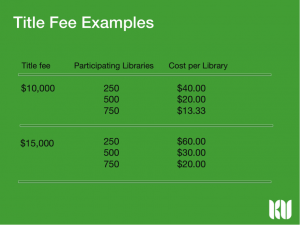
The Knowledge Unlatched publishing model sees many libraries coming together and sharing the publishing costs for electronic books. Basically this means that a book can be made fully Open Access for only a small investment of under a hundred pounds in some cases.

TitleFee  

 St Andrews University Library took part in the first round of the pilot project and currently has 22 ebooks on the library catalogue purchased through the system. More information can be found here.

Composing the Party Line


Ebooks such as this offer users a unique experience differing from normal ebooks due to the way they can be reused and distributed. All the ebooks created through the Knowledge Unlatched platform carry Creative Commons licenses which permit copying, redistribution, and adaptation into different forms. This is a far more attractive proposition than the sometimes very restrictive ebook policies offered by some publishers.


From everyone here, well done Knowledge Unlatched and keep up the good work.


Monday, 12 May 2014

The future of books: what do researchers want?

Please help a major research project to understand how you use books.             

OAPEN-UK, an AHRC and Jisc-funded project on open access monographs, is currently running a survey to understand how researchers in the humanities and social sciences use books, and especially monographs.

The survey design has been informed by a range of funders including HEFCE and Jisc, and the findings will help build an evidence base for future policies to support monograph publishing in the UK.  

No identifiable data will be made public or shared beyond the OAPEN-UK project team. All respondents to the survey can enter a prize draw to win up to £100 of Amazon vouchers.

I hope you’ll spare 10-15 minutes to participate, and to help the researchers understand what you want as both authors and readers of books.

The survey can be found here: https://www.surveymonkey.com/s/K96XZD5 (closes 6 June 2014)

If you have any questions, please contact the survey researcher, Ellen Collins, on ellen.collins@researchinfonet.org


The survey will form an important input into the HEFCE Monographs and Open Access Project. This study aims to examine the difficulties facing open access publishing for monographs. HEFCE has set up an Expert Reference Group to establish what evidence is needed to inform understanding in this area, and to provide advice on an appropriate programme of work to gather this evidence.

Monday, 21 October 2013

Information about open access books added to libguide

To start this year's Open Access Week, the Library has added to its Libguide on open access with a page about open access monographs.

In addition to developments in journal publishing, there are many exciting things happening with book publishing. We have provided some basic information, with links to details on recent developments including new business models. You can also find information about projects and publishers, and how to search for open access books.

See the new guide at http://libguides.st-andrews.ac.uk/oabooks

Monday, 26 August 2013

Publisher extends open access choice to monographs

Scholars in Humanities and Social Sciences now have an opportunity to publish open access monographs with Brill’s new initiative:
“As a major publisher in the Humanities, Social Sciences, Biology and International Law, Brill is committed to enhancing access to academic content in any sustainable way. Since its academic book publications are a cornerstone of the program, it is extending Brill Open to include monographs and edited volumes.”
Under Brill's OA option, authors retain copyright and can choose from 2 Creative Commons licences (CC-BY / CC-BY-NC), determining whether commercial re-use is allowed and the cost of the Book Publication Charge. At EUR 5000 for a 350-page book under the CC-BY-NC licence, this ties in with the typical production costs mentioned by Open Book Publishers of £3,500-£5,000, and suggests that a business model for open access book publishing is achievable and affordable.

With the Wellcome Trust extending their open access policy to include scholarly monographs and book chapters* from October 2013 we are likely to see more publishers announcing their options for authors soon.

Previous blog post on examples of OA books and new publishing models

*Wellcome Trust's Monograph and Book Chapter FAQ

Wednesday, 19 June 2013

'Open Access' now open access

Essential reference book Open Access, by Peter Suber, is now available in multiple open access formats from MIT Press:
In this concise introduction, Peter Suber tells us what open access is and isn’t, how it benefits authors and readers of research, how we pay for it, how it avoids copyright problems, how it has moved from the periphery to the mainstream, and what its future may hold. Distilling a decade of Suber’s influential writing and thinking about open access, this is the indispensable book on the subject for researchers, librarians, administrators, funders, publishers, and policy makers.
Peter Suber is  Director of the Office for Scholarly Communication Office at Harvard, Director of the Harvard Open Access Project, a Faculty Fellow at the Berkman Center for Internet & Society, and Senior Researcher at SPARC (Scholarly Publishing and Academic Resources Coalition). He is widely considered the de facto leader of the worldwide open access movement.
The book continues to be available in paperback, and is now freely available in ePUB, Mobi, PDF and HTML from http://mitpress.mit.edu/books/open-access

Friday, 21 December 2012

Open books and new publishing models

Following a recent request from one of our Schools for titles published by Open Book Publishers, we have now added the full list of OBP open access books to SAULCAT, the St Andrews University Library Catalogue.

Open Book Publishers (OBP) represents an innovative model of scholarly publishing, where all titles are available as free digital versions from the OBP site, and additional formats including pdf and print can be purchased. Some of OBP's publishing costs are covered by research grants awarded to authors, and the income from the additional formats ensures this model of open access publishing is sustainable.

We have already noticed some demand for print copies, for example we have purchased a copy of The theatre of Shelley / Jacqueline Mulhallen in addition to the open access version.

Read more about the OBP 'success story' at http://www.oastories.org/2011/10/open-book-publishers/ and recent article in THE

OBP is just one of a number of developments taking advantage of the digital environment to create open access books. The Open Access Scholarly Publishers Association (OASPA) blog provides a useful roundup from a recent conference session: Spotlight on Open Access Books at COASP 2012

While much of the OA debate surrounds the response to new funder policies and published journal articles, we are seeing an exciting future for OA books. Publishing models include consortial funding by libraries, funding from University presses, re-use of exisitng 'CC' licensed content, collaborative peer review and publishing by groups of academics, income generation through add-on services such as print-on-demand.

Further examples of OA books:  

Friday, 2 November 2012

The humanities and open access: opportunities and challenges

It is now a week since the main event hosted by the University of St Andrews Library for Open Access Week: The humanities and open access: opportunities and challenges, and we have had time to reflect on some very interesting presentations and discussions. The keynote address and Q and A session from Professor Gary Hall are now available on YouTube, and a summary of the rest of the day follows.

12:10 Starting the open access journey - why choose open access?Dr Chris Jones (Director of Research, School of English, University of St Andrews) Chris has wide research interests in poetry, especially that of the Anglo-Saxon period and the nineteenth and twentieth centuries. 
Chris started off by giving us his perspectives on open access self-archiving. He remembers being intrigued, though 'a little scared', at the idea of striking out the clause on copyright assignment in his early publishing career. He now finds that more publishers will give permission to deposit in a repository. He is concerned about the authority of published work being accepted when it is open access (he acknowledges the REF may be seen as the ‘problem’ here) but he has also learnt that good metadata and the possibility to add coversheets to author versions ensures that definitive versions can be cited.

12:20 'Why open access is important for the humanities, the University, everyone...'Professor Gary Hall (coventry University and open humanities Press) Gary Hall is Professor of Media and Performing Arts and Director of the Centre for Disruptive Media at Coventry University, UK. He is author of Culture in Bits (Continuum, 2002) and Digitize This Book!: The Politics of New Media, or Why We Need Open Access Now (Minnesota UP, 2008).In 1999 he co-founded the open access journal Culture Machine, which was early champion of OA in the humanities. In 2006 he co-founded Open Humanities Press (OHP), the first OA press dedicated to contemporary critical and cultural theory, which currently has 14 journals in its collective. An OHP monograph project, run in collaboration with the University of Michigan Library’s MPublishing, was launched in 2009.
 
Gary enlightened us with philosophical theories about ‘authorship’ and described the ideological motives behind open access, suggesting scholarship should be about cultivating ideas rather than ‘owning’ a definitive stance on a subject. He asked: ‘Do we need to explore new ways of being academics?’

He went on to describe a number of practical projects that creatively engage with open access, for example allowing contributors to learn about OA issues as they draw content from existing OA sources and repackage it, as in the Living Books about Life series. In the OHP monographs, scholars ‘come together’ around a topic of interest and carry out the editorial work. Each project facilitates a learning experience for authors and reviewers as well as new reusable content for a global readership, thus changing scholarly publishing culture.We heard about the importance of credibility, and this is being answered through the academic networks involved in OHP and the international experts on various Editorial Boards.


The Q & A section focussed on issues of quality, and it was recognised that academics need to consider when, and how far, they push the boundaries of ‘traditional’ publishing.


14:00 Journal hosting services
Angela Laurins & Claire Knowles (Digital Library, University of Edinburgh) [Presentation on slideshare]
Angela gave us an overview of Open Journal Systems (OJS), how it is used globally and the variety of approaches in Edinburgh University’s journal hosting service. We saw how easy it could be to set up and run a new journal with an open access model ‘out of the box’, leaving time for people to concentrate on quality and promotion of content. Claire described how they have helped journal managers use statistics to analyse their readership, for example forging links with Universities in regions where they see a high volume of visitors.

Janet Aucock & Jackie Proven (Library, University of St Andrews) [Presentation on slideshare]
Janet described how a journal hosting service moved from initial conversations about what might be possible, to an embedded service. Jackie continued the idea of conversations to explain the iterative process of setting up hosted journals, and how we have found it a learning experience for all involved.

Gillian Duncan (Centre for the Study of Terrorism and Political Violence, University of St Andrews)
Gillian gave a case study of how and why the Journal of Terrorism Research uses OJS, particularly the opportunity it gives to students and early career researchers to get experience of publishing. Open access is crucial to many of their readers who could be located in war zones without easy access to subscription journals.

14:45 Disciplinary perspectives
Dr Guy Rowlands (Centre for French History and Culture, University of St Andrews)
Guy gave a detailed account of how he came to publish an open access ebook series: St Andrews Studies in French History and Culture. 2 years ago he saw a need for shorter-length works (25 – 50,000 words), and describes them as ‘midigraphs’. (It is interesting to note Palgrave’s recent move to introduce works of this length in the humanities and social sciences, with its Pivot imprint). Print copies are currently produced for major libraries and as promotional tools, but print versions will be phased out by 2015 when he believes open access versions will have sufficient credibility to stand alone. He is very encouraged by the level of downloads from Research@StAndrews:FullText – far surpassing what print sales would achieve.

Prof Mario Aguilar (School of Divinity, University of St Andrews)
We were given an interesting insight into the Editorial process of an open access journal: Sociology Mind and the way that scholarship happens when ideas are challenged. Through layers of peer review before and after publication, we heard how how ‘open access open a new world’. The quality of articles is improved over time, as well as their ability to reach far corners of the globe.

Dr Sarah Dillon (School of English, University of St Andrews)
Sarah started by saying she found out by accident she was involved with open access – as she had simply chosen to publish with the most appropriate publisher and it turned out to be Open Humanities Press. Work on her research project ‘What Scientists Read’ has also led her to consider visibility and impact of her outputs, and how open access can really help with public engagement. She then described the very real issues faced by academics faced with pressure to publish with ‘reputable’ publishers when research assessment was imminent, perhaps being forced into an outdated publishing format by prevailing culture. She suggested academics have real power to change things, and they need to use it to push boundaries.

In summing up this section, Guy reminded us that what hasn’t changed for scholarly communication since the 17th century is the importance of credibility.

15:35 Open access projects and current awareness [Presentation on slideshare]
Jeremy Upton (Deputy Director of Library Services, University of St Andrews)
Jeremy highlighted new developments with open access ebooks, particularly the OAPEN initiative and Knowledge Unlatched

15:45 Institutional/library perspectives
John MacColl (University Librarian and Director of Library Services, University of St Andrews)
John rounded off the day with some quotes from each of the presenters to illustrate the hopeful and  inspirational opportunities offered by open access, as well as the pragmatic and sometimes difficult challenges we face in this period of transition.

Wednesday, 17 October 2012

Is open access the future of scholarly publishing?

Open access is bringing exciting changes to scholarly communication. It is currently a widely discussed and debated topic by government, institutions and publishers. Open Access Week provides an opportunity to come and find out why open access is important for you, your institution, your discipline, and everyone.

St Andrews University Library has organised a special event on Friday 26 Oct, 11.30-16.30:
The humanities and open access: opportunities and challenges in  Parliament Hall, South St, St Andrews
*Register (free) online*
Our invited speaker, Gary Hall, will explain why open access is important by focusing on a number of projects that creatively engage with open access research and publications:
AirCover1.jpgThis talk will explain why open access is important for the humanities, the University, indeed everyone. In will do so by focusing on a number of projects that creatively engage with open access research and publications, including Living Books about Life (www.livingbooksaboutlife.org), aJISC-funded series of over twenty open access books which provides a bridge between the humanities and the sciences. Produced by a globally-distributed network of writers and editors and open to ongoing collaborative processes with readers, these ‘living’ books repackage existing open access science research by clustering it around selected topics to form a series of coherent single-themed volumes - on air, bioethics, cosmetic surgery, extinction, human geonomics, pharmacology, veterinary science and so on. As the title of the project suggests, the theme that unites the volumes in the series is life, understood both biologically and philosophically.

Read more about Living Books about Life on @ the Library blog
All the books are available on our library catalogue

We will also hear about open access activities from academics in St Andrews, new journal hosting services in both St Andrews and Edinburgh University libraries, and more. While focusing on the humanities, this event will be relevant for anyone who needs to understand why open access is important.

Lunch and refreshments included - come and join us for a lively debate!


Friday, 24 August 2012

Free ebook explores women and wills in French history

NEW published Aug 2012:
"For the salvation of my soul": women and wills in medieval and early modern France edited by Joëlle Rollo-Koster and Kathryn L. Reyerson
ISBN 978-1-907548-09-3

We are delighted to announce the publication of volume 5 in the St Andrews Studies in French History and Culture series, available from Research@StAndrews:FullText. This open access ebook is the latest to be published by the St Andrews Centre for French History and Culture, free for consultation, downloading, printing or circulation, either for private use or for educational purposes. The earlier volumes have had a high number of downloads and initial indications are that this new title will continue this success.
This volume seeks to investigate the testamentary practices of women in medieval and early modern France, examining the experience of a cross-section of the population, from artisans to the elite, in Aix-en-Provence, Avignon, Marseille, Montpellier, La Rochelle, Brittany, and Burgundy. The making of a will was perhaps the single most prominent moment in women's lives for the assertion of agency. Though constrained to some degree by customary practice and the increasing influence of Roman law, women demonstrated remarkable initiative in the formulation of their last wishes. Wills permitted women to reward friendship and loyalty, to designate universal heirs as major beneficiaries, to stipulate conditions of inheritance so that last wishes were carried out, and, perhaps most importantly, to make pious donations to the Church for the salvation of the testators' souls. They chose their burial sites and arranged for funeral processions, and they endowed anniversary masses for their souls in perpetuity. Individual testamentary decisions differed, as did spousal strategies, but the reinforcement of family ties, even the assertion of relationship, was possible in wills.
The series can be accessed online from our repository and is also available as print-on-demand from the Centre for French History and Culture.

Friday, 13 April 2012

Discovery service for open access books

The Directory of Open Access Books (DOAB) has just been launched with over 750 academic books available under an Open Access licence.

Books are available in a range of subjects with a particularly strong presence in History and Social Sciences.

DOAB ensures that books are available to readers with as few restrictions as possible, and requires that academic books in the directory are peer reviewed prior to publication.

DOAB is a service of the OAPEN Foundation, and policies have been developed in conjunction with the Open Access Scholarly Publishers Association (OASPA).

Press release:

Wednesday, 20 July 2011

Recent St Andrews open access ebook highly accessed

The latest open access ebook in the St Andrews Studies in French History and Culture series is in the Top 3 most viewed items from Research@StAndrews:FullText for the last month.

Proven patriots”: the French diplomatic corps, 1789-1799 by Linda S. Frey and Marsha L. Frey is the third in the series of midigraphs produced by the St Andrews Centre for French History and Culture.

Highlighting their open access availability, the introduction to the series states: "In keeping with the mission of the Centre to enhance public understanding of the Francophone world, these publications are free at the point of delivery and come with no charge for consultation, downloading, printing or circulation, either for private use or for educational purposes. Copyright is asserted merely in order to protect the works as the intellectual production of individual scholars."

The series covers the full span of historical themes relating to France: from political history, through military/naval, diplomatic, religious, social, financial, cultural and intellectual history, art and architectural history, to literary culture. Titles in the series are rigorously peer-reviewed through the editorial board and external assessors.

The series can be accessed online from our repository and is also available as print-on-demand from the Centre for French History and Culture.