Earlier this year we welcomed a postgraduate student to the University Library to carry out an Erasmus internship. This guest blog post by Juan Mosquera Ramallo provides a flavour of his time spent working with research data, open access publications and e-theses:
A whole summer has passed after my two-month internship at St Andrews’ University Library and I think the time has come to reflect on what this experience has taught me. As a mature Postgraduate student (I am in my forties) at the Erasmus Mundus Masters programme ‘Crossways in Cultural Narratives’, supervised by the Modern Languages Department, I believed that St Andrews’ University Library was an interesting place to learn about academic information and resources. Working in the library is an excellent way to learn about the problems and issues of organizing, cataloguing and disseminating those data. I learned a lot during these two months about these issues but if there is a word which has been emphasized through all the tasks I had to perform there is this (and I write it in capital letters): ACCESSIBILITY. I was amazed at how all the staff in the library are committed not only to preserving and storing knowledge, but also to finding new ways to make that knowledge easily and freely accessible. All this was done in accordance to the policy shift towards Open Access (OA) which is being promoted by the British government in an effort to make all new knowledge available to the general public as soon as possible. In a certain way, the main lesson I have learnt is to avoid becoming “selfish” with the knowledge I will produce (in my hypothetical future academic career), but trying to spread it as much as I can using all the tools at my disposal.
During my internship, all the different tasks I was assigned were related to OA policy; therefore I will describe how my performance was contributing to the development of OA.
1. As the Open Access policy involves not just free access to articles that are the result of researches funded by public bodies, but also free access to the data used in these researches, it is important to check whether this access is actually free or not. Therefore, part of my task in collaboration with the Head of Research Data and Information Service was to introduce myself into the online journals to examine the articles produced by researchers from the University of St Andrews. Though the articles were freely available on these websites, it was necessary to observe whether the relevant data used in the research were available as well. This meant verifying whether or not the supplementary information related to the articles included figures, diagrams, statistics, materials, etc. which constituted both the primary data from which the research was based, and the results which were the product of the specific research addressed in the article. This supplementary information could be included as an appendix to the article itself in the form of a file which contained all this data information, as a link to another website where this data information was stored, or in the form of a statement within the article explaining how to access this information. This verification was not only a matter of seeing whether this information was freely accessible or not, but also a matter of how easy it was to reach, if the accessibility was clear and straightforward.
2. This is a moment of transition in the implementation of the Open Access policy, so the different institutions linked to research supported by public funding are still organizing their own protocols and ways to access research articles. As a result of this policy, an increasing number of educational institutions and public bodies are setting up repositories as a way to make the research outcomes funded with public resources freely accessible; this is concomitant with, rather than a replacement of the traditional publishing through academic journals. My task was to examine different online repositories established by diverse institutions (mainly universities) and to see how these repositories were organized in terms of the accessibility of articles and data, the different identifiers used to classify the stored items and the available links to additional information. In this way it would be easier to identify the strengths and weaknesses of repositories regarding the successful application of the Open Access policy and to take this into account in the re-design of the University of St Andrews’ repository.
3. Under the supervision of the Head of Metadata and Content Acquisition, I had the opportunity to work with the theses produced at University of St Andrews that, in accordance with the University Postgraduate Code of Practice, have to be deposited in electronic format. This accessibility implies not only the possibility of having printed theses at the public’s disposal but also the inclusion of the theses in the St Andrews’ repository where everybody can read them in a digital version, facilitating the diffusion of knowledge originating from the University’s PhD research. Since 2007, the University of St Andrews’ PhD theses have been produced both in paper and digitized versions. Due to the huge number of pre-2007 PhD theses which are still only in paper versions, these theses, in collaboration with the British Library’s EThOS service, are digitized on request of the individuals who want to access them. My task involved the inclusion of these digitized versions in the University’s repository after downloading the theses files from the Ethos database. At the same time, it is necessary to create metadata records in the repository that provide information about the content of the diverse theses and allow an easier identification and labelling of the topics addressed in them. The inclusion of this metadata in the interface of the University’s library was an essential part of my work as well.
4. The RCUK (Research Councils UK) is a strategic partnership of the UK’s seven Research Councils and invests millions of pounds every year in research. Different institutions carrying out research receive funding from the RCUK in order to make the result of their works available through the application of the Open Access policy, which asks for Open Access immediately at the time of the on-line publication when payment is made to a publisher. Due to the funding support, the RCUK monitors how institutions use this money and asks from them evidence to observe how the Open Access policy is working. St Andrews University Library manages the grant assigned by the RCUK and checks the compliance of all the requirements for the Open Access documents published. My task was the compilation in a standard spreadsheet of the relevant data asked by the RCUK so that it can serve as evidence of the implementation of the Open Access policy and of the rational use of the grant. Eventually this data will be made public so that the whole University sector and UK funding bodies will see what is being spent (and the compliance rates) from as many institutions as possible.
In conclusion, my work placement was a very interesting experience which made me reflect on the relationship between researching, publishing and accessibility, and how institutions like university libraries play a relevant role in these activities. In a certain way, I have changed my mind: prior to this experience, the research ended for me at the moment the paper with the results were written; now I consider that the researcher has to work to make that paper visible and accessible, not just for professional reasons, but also to share this new knowledge with others. Researchers working at universities have an ally in the libraries that can help them to do this. I really enjoyed my internship there and I would like to thank the library staff who helped me during my whole stay, being patient with me and introducing me to a whole new area linked to the dissemination of new knowledge. Their professionalism and kindness created a friendly atmosphere which contributed to a very pleasant and stimulating experience, and to change my mind regarding university libraries: there is so much happening behind those quiet rooms!
Showing posts with label e-theses. Show all posts
Showing posts with label e-theses. Show all posts
Thursday, 29 October 2015

Wednesday, 1 April 2015
Share My Thesis competition - update

Last week the British Library Ethos service announced the winner of the Share My Thesis competition. We posted about the competition back in January, see here for more information.
The entrants had to first tweet about why their research is/was important using the #ShareMyThesis hashtag. The 8 shortlisted entrants then had to write a short article to elaborate on their tweet. You can read the winning entries here: 1st, 2nd, and 3rd.
Although the competition is now closed, the British Library Ethos service still encourages PhD students past and present to use #ShareMyThesis to share their PhD research with a wider audience.
Monday, 30 March 2015
5000th repository item - update
This is a quick update on the 5000th item in the repository we highlighted back in February: A phenomenological-enactive theory of the minimal self, by Brett Welch. We sent Brett a copy of Martin Paul Eve’s book Open Access and the Humanities as a prize. Last week he received the book and was kind enough to send us a picture (we especially like the Saltire in the background!)

You can read Brett's thesis here: http://hdl.handle.net/10023/6043
Martin Paul Eve's book is also freely available to download and read online through our library catalogue, here: http://library.st-andrews.ac.uk/record=b2173431~S5

You can read Brett's thesis here: http://hdl.handle.net/10023/6043
Martin Paul Eve's book is also freely available to download and read online through our library catalogue, here: http://library.st-andrews.ac.uk/record=b2173431~S5
Friday, 6 February 2015
We now have 5000 items in the repository!
We’ve reached another milestone! We now have over 5000 items in the repository, with a variety of research outputs including theses, reports, books, chapters, journal articles completely free and available for anyone to read.

We have reached this milestone in only 6 months, whereas the previous 1000 milestones took around 12 months. The graph above reflects the recent upsurge in activity. This is largely a response to two recent policies that have helped to reshape the UK higher education publishing landscape. Firstly, Research Councils UK (RCUK) produced an open access mandate requiring RCUK funded authors to make their research outputs open access either by paying an Article Processing Charge (APC) for "gold" access, or by depositing an accepted manuscript in a repository ("green" open access). RCUK later requested a report by institutions who had received a block grant to fund APC payments. They wanted to see where the money had been spent and how much impact the money was having on open access compliance. The library produced a report in September 2014 that showed our compliance rate at 71%, which comparatively speaking was excellent. This involved a lot of communication between the Open Access team and academic colleagues to ensure that those with RCUK grants knew about the open access requirements. The reaction from the academic community was very positive, and this is reflected in the 71% figure.
The second big motivator contributing to the increased activity is undoubtedly the HEFCE open access policy for the next Research Excellence Framework (REF). In a nutshell, the policy states that articles and conference proceedings must be deposited in a repository when they are accepted for publication in order to be included in the next REF. Although the policy doesn’t come into effect until April 2016, the Open Access team has been working hard over the past few months promoting the message, and ensuring that the research community is compliant well in advance. The Open Access team have delivered presentations at Physics and Astronomy, Biology, Chemistry, Economics & Finance, Management, Computer Science, Philosophy, and History. We have also been invited to Earth & Environmental Sciences and Medicine. In support of the presentations we have also been communicating the message through email, having contacted over 80 authors in 16 Schools and Departments across the University.
 |
| Copyright Stephen Ritt, CC-BY-SA |

We continue to have electronic deposit of our postgraduate research theses into Research@StAndrews:FullText according to University regulations, and the 5000th item in the repository was the PhD thesis A phenomenological-enactive theory of the minimal self, authored by Brett Welch. The thesis presents a fascinating study of self-hood derived from two areas of research: phenomenology and enactivism. To mark the occasion we will be sending a copy of the book Open Access and the Humanities by Martin Paul Eve to Brett at his home in the United States. Martin Eve's book is available open access from the publisher's website and in print form.

The repository holds theses going back to 1949 and, at the time of writing, theses account for 35% of the content, totalling 1,752 items. David Collins is the thesis contact in the OARPS team, and the person responsible for archiving and mediating the deposit of most of the thesis content in the repository. The work involved in obtaining permissions to archive theses is complex and requires a great deal of time and effort. But the rewards for doing so are great as it increases the visibility of the theses and also showcases the high quality postgraduate research the University of St Andrews is famous for.
In the preface to Martin Eve's book, Peter Suber (who's book entitled Open Access is also available freely from publisher) writes about the difference in open access uptake between the humanities and the sciences. He suggests that the reason the humanities have been slower to adopt open access has nothing to do with lack of desire, but is rather because there are fewer working examples of open access in the humanities to prove that it works. We think that it is safe to say that Brett's thesis adds to the body of working examples we have collected in the repository, and, hopefully, it can prove to be an inspiration to others.
Well done to Brett!
Friday, 23 January 2015
EThOS #ShareMyThesis competition now open!
 |
| Copyright © The British Library Board |
The British Library EThOS service has started a Share My Thesis competition (in collaboration with Vitae and Research Councils UK).
How to enter:
Entry for the competition is through twitter using #ShareMyThesis. Entrants must explain in a single tweet why their doctoral research is important.
The fine print:
Entrants must have either completed their PhD degree or be currently studying for a PhD. Equivalent degrees such as DPhil are also allowed. Entrants must only tweet once, and also ensure that their tweet is understandable to a lay audience.The full terms and conditions can be found here.
The next stage of the competition will see the authors of the best 8 tweets write a short article elaborating on what they wrote previously, explaining in more detail why their research is important. This article will be in the style of a blog post no more than 600 words long.
First prize is a 15" retina display MacBook Pro! Second prize is an iPad, and third is a £200 Amazon voucher.
The closing date for entering your tweets is 9th February 2015 at 10am.
A bit about EThOS: The British Library EThOS service aims to increase visibility to UK doctoral research theses by compiling records of all UK doctoral theses in one database. It also offers free access to the full text of as many theses as possible either by links to institutional repositories (such as our own) or directly through the EThOS database. EThOS also offers a digitisation on demand facility where users can request that a thesis be scanned and uploaded to the database. EThOS will then contact the corresponding institution and request that a copy be sent for digitisation. Many St Andrews theses have undergone this process, and we have found that many older theses have found a new lease of life afforded by the greater degree of visibility. The benefits of the EThOS service were perfectly presented in a previous blog post by a postgraduate work experience student Maja, so rather than repeat her words, I'll simply suggest you have a read of her post.
Friday, 22 August 2014
4000 items milestone: Featured researcher: Dr Fabiola Alvarez
In recent weeks we have been celebrating reaching 4000 items in the repository by showcasing some of the researchers who have been instrumental in attaining the milestone. We have already highlighted DR. Kim Mckee, Professor Derek Woollins, and Professor Alexandra Slawin for their invaluable input. In this blog we will be shining the spotlight on another researcher whilst also highlighting a highly important aspect of our repository: E-theses.
Since September 2006 the University of St Andrews has required all theses to be submitted electronically to the repository. This has the advantage of making the details of research outputs immediately visible. In most instances the full text is also made available, thus increasing the visibility and impact of the research. One such thesis is The Scottish national screen agency: justifications of worth by Dr Fabiola Alvarez.
Dr Fabiola Alvarez attained her PhD earlier this year. Her doctoral research was concerned primarily with the demise of the Scottish Screen agency for Scotland which was disbanded in 2010. In her thesis, Fabiola came to the conclusion that the incompatibility between different forms of valuation within the agency and among its stakeholders played a role in its demise, and specifically there were internal disagreements over the worth of projects which caused conflict over funding decisions.
We approached Dr Alvarez for her thoughts on Open Access:
Creative Scotland has since taken the responsibility of distributing funding for Scottish creative arts. It is interesting to see that this year Creative Scotland set out a 10 year plan which aims to provide a "shared vision for the arts, screen and creative industries in Scotland". Although it is not clear whether academic research influences public bodies, the value of such research being Open Access is that it helps to create further research and might positively influence public policy and decision making in the future – Fabiola’s vision of harmonious “academic and non-academic activity”.
So, from all of us in the Open Access and Research Publications Support (OARPS) team, thank you Dr Fabiola Alvarez for your contribution to the 4000 celebration.
 |
| © University of St Andrews |
Since September 2006 the University of St Andrews has required all theses to be submitted electronically to the repository. This has the advantage of making the details of research outputs immediately visible. In most instances the full text is also made available, thus increasing the visibility and impact of the research. One such thesis is The Scottish national screen agency: justifications of worth by Dr Fabiola Alvarez.
 |
| © University of St Andrews |
Dr Fabiola Alvarez attained her PhD earlier this year. Her doctoral research was concerned primarily with the demise of the Scottish Screen agency for Scotland which was disbanded in 2010. In her thesis, Fabiola came to the conclusion that the incompatibility between different forms of valuation within the agency and among its stakeholders played a role in its demise, and specifically there were internal disagreements over the worth of projects which caused conflict over funding decisions.
We approached Dr Alvarez for her thoughts on Open Access:
"The thoughts that come to mind about open access is that it was definitely useful to me during my years as a PhD student (which obviously are still very fresh in my mind) and it continues to be so now that I'm working on my first academic paper. I hope that, by the same token, the possibility to easily access my and other people's work will be useful to others - not only students and academics, but also people working in other domains who, like me, would like to see a growing rapprochement between academic and non-academic activity."
 |
| © Scottish Screen |
 |
| © Creative Scotland 2014 |
So, from all of us in the Open Access and Research Publications Support (OARPS) team, thank you Dr Fabiola Alvarez for your contribution to the 4000 celebration.
Wednesday, 4 June 2014
‘Scottish competition bagpipe performance…’ : first Royal Conservatoire of Scotland postgraduate thesis added to Research@StAndrews:FullText
Since 2000, the Royal Conservatoire of Scotland, Scotland's national centre of professional vocational training in performance arts, has offered research programmes leading to the awards of Doctor of Philosophy (PhD) and Master of Philosophy (MPhil). These postgraduate research degrees are validated and awarded by the University of St Andrews.
The Royal Conservatoire currently doesn't have a mandate for the electronic submission of theses. However, there is a desire to make as much of their thesis content electronically available, where possible. The University's digital repository, Research@StAndrews:FullText, is the ideal place to make that happen. Also, given the nature of the Royal Conservatoire's theses; multimedia, performance-based, and the associated copyright issues that can arise, the St Andrews repository staff are best placed to deal with these, given their experience of copyright issues in theses.
Consequently, in the repository there is now a collection specifically for the Royal Conservatoire of Scotland's theses, and the first title, hopefully the first of many, has been added:
'Scottish competition bagpipe performance : sound, mode and aesthetics' by Simon McKerrell.
Although the aforementioned copyright issues can be complicated, it is hoped that by working together, the Royal Conservatoire of Scotland and the University of St Andrews will be able to realise their shared goal of making the fruits of research electronically available to all.
Thursday, 6 February 2014
Using doctoral theses in your research: a guide to EThOS
Do you want to find out how UK PhD theses can be accessed? Here is a quick reminder of a training webinar which is being organised by the EThOS team at the British Library:
Register to attend the webinar at https://attendee.gotowebinar.com/register/5974661878725146370
St Andrews is a fully participating member of EThOS. Find out more on our Library web pages
Using doctoral theses in your research: a guide to EThOS.The session takes place on Thursday 13 Feb 2014 at 15:00
EThOS (http://ethos.bl.uk) is the national database for PhD theses, managed by the British Library. It’s a fantastic resource for researchers, with over 100,000 UK theses freely available to download and use for your own research, and another 200,000 available to search and scan on demand. Find out how to search for and download theses, and what to do if a thesis isn’t available. If you’re a PhD student, find out what will happen to your thesis once it’s completed. We’ll also explain how EThOS works with UK universities to support the whole research cycle, making the theses more visible and available for new researchers to use and build on.
Register to attend the webinar at https://attendee.gotowebinar.com/register/5974661878725146370
St Andrews is a fully participating member of EThOS. Find out more on our Library web pages
Thursday, 11 July 2013
Thesis highlights academic value of Special Collections
Amidst the many treasures of Special Collections lies the Von Hügel Collection. At around five thousand volumes it represents a significant gathering of 19th and 20th century works on philosophy, religion, and history, as well as original and annotated manuscript papers. Assembled by Baron Friedrich von Hügel (1852-1925), Hon. LLD St Andrews 1921, it was bequeathed to the university upon his death in 1926.
Von Hügel’s philosophy is still debated, and this year St Andrews doctoral student Robyn Wrigley-Carr made a contribution to the scholarship with her PhD thesis: ‘The Baron, his niece and friends: Friedrich von Hügel as a spiritual director, 1915-1925’. This serves to prove that these documents, and many other Special Collection texts like them, although valuable for their beauty and antiquity, are also a key research tool for scholars.
Special Collections rightly keeps its valuable store well-guarded and looked after, so they probably wouldn’t be too pleased if you wandered in for a browse with a muffin, but you are welcome to read Dr Wrigley-Carr’s thesis whilst shedding as many crumbs as you like:
http://hdl.handle.net/10023/3588
Heather Curtis (Guest blogger & intern)
BBC request St Andrews thesis
Every student to pass through St Andrews leaves a legacy in one form or another, and for our postgraduates this often takes the shape of a thesis. The university requires students to submit a copy of their thesis to the library in order to graduate, but who is it that might end up reading your precious creation, years or even decades after you have gone?
Well, you’ll be pleased to know they’re not just propping up the desks here in the underbelly of the library where the repository work takes place, and unfortunately they make for rather unwieldy coasters. In reality, whether in digital or print form they are a tangible monument to our university’s research excellence, and recently an urgent call came through from the BBC. It’s not unusual for us to receive requests for viewings from scholars around the country, primarily through the British Library’s EThOS service, but last month the team behind ‘Coast’ requested a copy of F. M. Fraser’s 1977 PhD thesis: ‘The Lewisian and Torridonian geology of Iona’ – on the double!
With a tight filming schedule on Iona to be met, there was no time to send it off to London for digitisation as would usually happen, and so it was rushed off to Special Collections to be scanned in-house. One week later we presented the BBC with four hundred pages of geographical goodness, saving the day by assuring there would be sufficient educational content to match the moody shots of Neil Oliver’s locks flapping about in the wind. Whoever said that library work isn’t glamorous?
Season 9 of ‘Coast’ will be hitting our screens in 2014, but for the keener amongst you, here is a link to Dr Fraser’s thesis in Research@StAndrews:FullText:
http://hdl.handle.net/10023/3812
Heather Curtis (Guest blogger & intern)
Monday, 25 March 2013
Highlighting open access outputs in School of Classics
Following collaboration between the Library repository team and School computing officers, the University of St Andrews School of Classics has developed new web pages highlighting content from Research@StAndrews:FullText.
Using RSS feeds and scripts to repurpose the data, the new Classics site provides a dynamic list of completed theses, with options to view abstracts and link to the full text. There are also handy links back to Library web pages with further information on finding theses and general advice on open access. (Note, not all theses are available to download immediately due to embargoes).
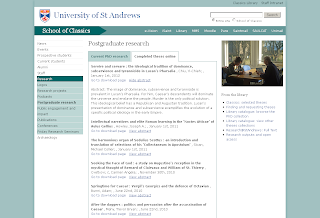
In addition there is a page that links to open access research publications by staff in Classics, all of which have full text available in Research@StAndrews:FullText
Our embedded usage stats show healthy downloads for some of these research outputs, for example 'Written Into the landscape : Latin epic and the landmarks of literary reception' (PhD thesis by James S McIntyre, 122 downloads) and 'Training athletes and explaining the past in Philostratus' Gymnasticus' (Book chapter by Dr Jason Konig, 70 downloads).
Link to School of Classics Postgraduate research and staff publications from http://www.st-andrews.ac.uk/classics/research/
Using RSS feeds and scripts to repurpose the data, the new Classics site provides a dynamic list of completed theses, with options to view abstracts and link to the full text. There are also handy links back to Library web pages with further information on finding theses and general advice on open access. (Note, not all theses are available to download immediately due to embargoes).

In addition there is a page that links to open access research publications by staff in Classics, all of which have full text available in Research@StAndrews:FullText
Our embedded usage stats show healthy downloads for some of these research outputs, for example 'Written Into the landscape : Latin epic and the landmarks of literary reception' (PhD thesis by James S McIntyre, 122 downloads) and 'Training athletes and explaining the past in Philostratus' Gymnasticus' (Book chapter by Dr Jason Konig, 70 downloads).
Link to School of Classics Postgraduate research and staff publications from http://www.st-andrews.ac.uk/classics/research/
Thursday, 5 July 2012
Repository content doubles in a year

We have now passed another milestone, with over 2000 items in our open access repository Research@StAndrews:FullText.
Our 2000th item turned out to be a little bit of Scottish History, with a thesis originally requested through the British Library's EThOS service:
Annette M. Smith (1975) The Forfeited Estates Papers, 1745: a study of the work of the Commissioners for the Forfeited Annexed Estates, 1755-1784, with particular reference to their contribution to the development of communications in Scotland in the eighteenth centuryThis adds to a thriving digital collection of Scottish History theses. Our most viewed item in this collection is Reading the Scottish Enlightenment : libraries, readers and intellectual culture in provincial Scotland c.1750-c.1820 which has been downloaded nearly 100 times.
Our project to deposit retrospective theses has also added to our varied collections including English, Mediaeval History, Modern Languages, Divinity, International Relations and Biology.
The deposit of research publications also continues through our Research Information System PURE, with a recent batch of Physics papers and outputs from our Biomedical Sciences Research Complex.
We look forward to doubling our open access content again next year, or perhaps aiming for 5000!
Tuesday, 3 July 2012
Countdown to 2000 in Research@StAndrews:FullText

Just over a year ago we celebrated reaching a landmark 1000 items in Research@StAndrews:FullText so it has been a busy and exciting year to see our content double.


There are now well over 1000 e-theses in the repository, over 500 research publications from our Research Information System PURE, nearly 300 Sustainable Development Commission reports and a range of other content including e-books and digitized items from our Special Collections.
The total has been boosted by a short project to upload nearly 200 theses from those requested through the British Library EThOS service, with the help of 2 interns. Most of these theses are in Humanities, with the earliest being a thesis awarded in 1949.
Specific titles will be featured on the blog as we reach this latest landmark total.
Our usage statistics also show an encouraging increase. Now over 4000 items are downloaded every month!

Monday, 5 March 2012
St Andrews supports e-theses online service
We are very encouraged by the recent news from EThOS, highlighting positive comments about the availability of UK PhD theses for a global audience.
 EThOS is a British Library national UK service for delivering electronic theses. Almost all UK universities participate in EThOS. St Andrews is part of this broad membership and contributes content regularly. At the end of 2011 there were 642 records of St Andrews e-theses in EThOS, of which 349 have full text available for immediate download.
EThOS provides an excellent showcase for our research and great visibility for our researchers, with 50,000 users registered with the service. Demand is researcher-driven and the request process means that theses only need to be digitized once for further reuse. EThOS reports over 4000 new e-theses being added in the second half of 2011, and around 10,000 downloads every month. Visibility will be further improved with plans to open up the metadata held in EThOS for use by discovery services.
Statistics for St Andrews e-theses show the 'long tail' effect, with usage reported on e-theses dating back to the 1950s, eg Augier, F. 1954. Crown colony government in Jamaica (4 downloads in 2011).
It is interesting to see the subject coverage, with the majority becoming available due to researcher requests. Divinity and Scottish History are well represented, for example:
Gombis, T.G. 2005. The Triumph of God in Christ: Divine Warfare in the Argument of Ephesians (18 downloads)
Hall, B.E. 1971. The Earls of Orkney-Caithness and their relations with Norway and Scotland, 1158-1470 (8 downloads)
Boardman, S.I. 1989 Politics and the feud in late mediaeval Scotland (4 downloads) Also available from Research@StAndrews:FullText
Usage data also reflects specific projects such as Digital Islam which brought over 900 Islamic Studies theses to EThOS. You can narrow your search to find the 47 Digi-Islam theses from St Andrews, for example
Bakar, M.D. 1993. Conflict of law and the Methodology of Tarjih: A study in Islamic legal theory (20 downloads)
O'Sullivan, S. 2002. Early Umayyad Syria: A study of its origins and early development (10 downloads)
St Andrews is an Open Access sponsor of EThOS, showing our financial support and commitment to the service.
Wednesday, 26 October 2011
Benefits of Research@StAndrews:FullText
Back in June, we celebrated reaching 1000 items in Research@StAndrews:FullText with some of the contributors to our landmark total. One of our thesis authors was unable to attend our event, but has been back in touch with comments about the repository.
 "In my field of biblical studies it often takes two to three years before thesis research is made accessible to scholars for consideration and interaction. The digital repository has made it possible for scholars to access my research on 1 Peter almost immediately after I defended my thesis. I am also grateful for the way in which this technology enables scholars all over the world to access my work with a internet connection and a Google search."
Kelly Liebengood, author of 'Zechariah 9-14 as the substructure of 1 Peter’s eschatological program'
Our new statistics have allowed us to see that Kelly's thesis has been downloaded several times. We can also see that visitors have found the full text through a global index of electronic theses in the US, called OhioLINK Worlwide Center, as well as through Google searches.
We are delighted that Research@StAndrews:FullText can support our researchers in this way.
Wednesday, 29 June 2011
'Quest for the fictional Jesus' celebrated in Graduation Week
The item marking our 1000th item in Research@StAndrews:FullText is a thesis from the School of Divinity by Margaret Ramey - The quest for the fictional Jesus : Gospel rewrites, Gospel (re)interpretation, and Christological portraits within Jesus novels
Other theses deposited on the same day included:
 The roles of the cathedral in the modern English Church, Peter Rowe - Divinity
Optically guided neuronal growth, David Carnegie - Physics & Astronomy
Enemy within the gates : reasons for the invasive success of a guppy population (Poecilia reticulata) in Trinidad, Caya Sievers - Biology
Authors attended a reception during Graduation week to celebrate their achievements with colleagues in the Library.
First portfolio thesis in Research@StAndrews:FullText
One of the recent items making up our 1000 total is a new format for our repository. The portfolio thesis by Geoffrey Sharwood-Smith has been deposited with enhanced metadata records in order to clearly describe its full contents - the main critical appraisal and 7 publications. Since its deposit, the thesis has already appeared in our Top 10 most downloaded items.
Commenting on our repository services, Dr. Sharwood-Smith says "I’m very impressed with the facility that you have given me to make my thesis searchable world wide."
 |
| http://hdl.handle.net/10023/1815 |
Commenting on our repository services, Dr. Sharwood-Smith says "I’m very impressed with the facility that you have given me to make my thesis searchable world wide."
Subscribe to:
Posts (Atom)