Earlier this year we welcomed a postgraduate student to the University Library to carry out an Erasmus internship. This guest blog post by Juan Mosquera Ramallo provides a flavour of his time spent working with research data, open access publications and e-theses:
A whole summer has passed after my two-month internship at St Andrews’ University Library and I think the time has come to reflect on what this experience has taught me. As a mature Postgraduate student (I am in my forties) at the Erasmus Mundus Masters programme ‘Crossways in Cultural Narratives’, supervised by the Modern Languages Department, I believed that St Andrews’ University Library was an interesting place to learn about academic information and resources. Working in the library is an excellent way to learn about the problems and issues of organizing, cataloguing and disseminating those data. I learned a lot during these two months about these issues but if there is a word which has been emphasized through all the tasks I had to perform there is this (and I write it in capital letters): ACCESSIBILITY. I was amazed at how all the staff in the library are committed not only to preserving and storing knowledge, but also to finding new ways to make that knowledge easily and freely accessible. All this was done in accordance to the policy shift towards Open Access (OA) which is being promoted by the British government in an effort to make all new knowledge available to the general public as soon as possible. In a certain way, the main lesson I have learnt is to avoid becoming “selfish” with the knowledge I will produce (in my hypothetical future academic career), but trying to spread it as much as I can using all the tools at my disposal.
During my internship, all the different tasks I was assigned were related to OA policy; therefore I will describe how my performance was contributing to the development of OA.
1. As the Open Access policy involves not just free access to articles that are the result of researches funded by public bodies, but also free access to the data used in these researches, it is important to check whether this access is actually free or not. Therefore, part of my task in collaboration with the Head of Research Data and Information Service was to introduce myself into the online journals to examine the articles produced by researchers from the University of St Andrews. Though the articles were freely available on these websites, it was necessary to observe whether the relevant data used in the research were available as well. This meant verifying whether or not the supplementary information related to the articles included figures, diagrams, statistics, materials, etc. which constituted both the primary data from which the research was based, and the results which were the product of the specific research addressed in the article. This supplementary information could be included as an appendix to the article itself in the form of a file which contained all this data information, as a link to another website where this data information was stored, or in the form of a statement within the article explaining how to access this information. This verification was not only a matter of seeing whether this information was freely accessible or not, but also a matter of how easy it was to reach, if the accessibility was clear and straightforward.
2. This is a moment of transition in the implementation of the Open Access policy, so the different institutions linked to research supported by public funding are still organizing their own protocols and ways to access research articles. As a result of this policy, an increasing number of educational institutions and public bodies are setting up repositories as a way to make the research outcomes funded with public resources freely accessible; this is concomitant with, rather than a replacement of the traditional publishing through academic journals. My task was to examine different online repositories established by diverse institutions (mainly universities) and to see how these repositories were organized in terms of the accessibility of articles and data, the different identifiers used to classify the stored items and the available links to additional information. In this way it would be easier to identify the strengths and weaknesses of repositories regarding the successful application of the Open Access policy and to take this into account in the re-design of the University of St Andrews’ repository.
3. Under the supervision of the Head of Metadata and Content Acquisition, I had the opportunity to work with the theses produced at University of St Andrews that, in accordance with the University Postgraduate Code of Practice, have to be deposited in electronic format. This accessibility implies not only the possibility of having printed theses at the public’s disposal but also the inclusion of the theses in the St Andrews’ repository where everybody can read them in a digital version, facilitating the diffusion of knowledge originating from the University’s PhD research. Since 2007, the University of St Andrews’ PhD theses have been produced both in paper and digitized versions. Due to the huge number of pre-2007 PhD theses which are still only in paper versions, these theses, in collaboration with the British Library’s EThOS service, are digitized on request of the individuals who want to access them. My task involved the inclusion of these digitized versions in the University’s repository after downloading the theses files from the Ethos database. At the same time, it is necessary to create metadata records in the repository that provide information about the content of the diverse theses and allow an easier identification and labelling of the topics addressed in them. The inclusion of this metadata in the interface of the University’s library was an essential part of my work as well.
4. The RCUK (Research Councils UK) is a strategic partnership of the UK’s seven Research Councils and invests millions of pounds every year in research. Different institutions carrying out research receive funding from the RCUK in order to make the result of their works available through the application of the Open Access policy, which asks for Open Access immediately at the time of the on-line publication when payment is made to a publisher. Due to the funding support, the RCUK monitors how institutions use this money and asks from them evidence to observe how the Open Access policy is working. St Andrews University Library manages the grant assigned by the RCUK and checks the compliance of all the requirements for the Open Access documents published. My task was the compilation in a standard spreadsheet of the relevant data asked by the RCUK so that it can serve as evidence of the implementation of the Open Access policy and of the rational use of the grant. Eventually this data will be made public so that the whole University sector and UK funding bodies will see what is being spent (and the compliance rates) from as many institutions as possible.
In conclusion, my work placement was a very interesting experience which made me reflect on the relationship between researching, publishing and accessibility, and how institutions like university libraries play a relevant role in these activities. In a certain way, I have changed my mind: prior to this experience, the research ended for me at the moment the paper with the results were written; now I consider that the researcher has to work to make that paper visible and accessible, not just for professional reasons, but also to share this new knowledge with others. Researchers working at universities have an ally in the libraries that can help them to do this. I really enjoyed my internship there and I would like to thank the library staff who helped me during my whole stay, being patient with me and introducing me to a whole new area linked to the dissemination of new knowledge. Their professionalism and kindness created a friendly atmosphere which contributed to a very pleasant and stimulating experience, and to change my mind regarding university libraries: there is so much happening behind those quiet rooms!
Showing posts with label discovery. Show all posts
Showing posts with label discovery. Show all posts
Thursday, 29 October 2015

Friday, 21 November 2014
The Repository: helping to feed the impact of research
Over the years, the OARPS team has spent a great deal of time acquiring academic manuscripts and releasing them to the world through the repository.

Much of our current work involves assisting academics with complying with funder open access mandates. For instance, the RCUK mandate states that RCUK funded research papers should be made Open Access either by choosing "Gold" and paying an APC charge, or by choosing "Green" and uploading the accepted manuscript of the final article to Pure (and then the library can transfer the paper to the repository).
Presently, the team focus has incorporated the new HEFCE open access policy for the next REF as well. The HEFCE open access policy states that in order to be eligible, the accepted manuscripts of articles and conference proceedings (with an ISSN) must be deposited in a repository. The HEFCE open access policy does not come into effect until 2016, but we are tying to push the message now so that we are 100% compliant by that point.
With both these cases the result is more content in the repository. But with deposit being imposed from on high the other benefits of depositing can sometimes play second fiddle. In light if this, we have chosen to show some of the usage metrics from a recent article in the repository. We hope this demonstrates that archiving in the repository can greatly benefit the Impact of research.
A great example is The meanings of chimpanzee gestures which received a lot of media attention when it was published. The authors deposited the accepted manuscript for the article into Pure, which then allowed the OARPS team to get the manuscript into the repository.
Here are some of the repository usage stats for the article:

With statistics like this you have to read between the lines a little bit, but one thing they definitely show is that the article received a lot of attention in July (this was when the article was being covered in the media). Crucially, the stats also tell us that the vast majority of those visiting the page ended up downloading the document. This reliably indicates that the majority of people visiting the page did not have access to the publisher version.
So, with the manuscript in the repository a wider range of people, who do not have a subscription to the journal, can read the full article. This means it can be distributed more widely through society, thus widening the reach of the paper and helping to feed the impact of the research.

Much of our current work involves assisting academics with complying with funder open access mandates. For instance, the RCUK mandate states that RCUK funded research papers should be made Open Access either by choosing "Gold" and paying an APC charge, or by choosing "Green" and uploading the accepted manuscript of the final article to Pure (and then the library can transfer the paper to the repository).
Presently, the team focus has incorporated the new HEFCE open access policy for the next REF as well. The HEFCE open access policy states that in order to be eligible, the accepted manuscripts of articles and conference proceedings (with an ISSN) must be deposited in a repository. The HEFCE open access policy does not come into effect until 2016, but we are tying to push the message now so that we are 100% compliant by that point.
With both these cases the result is more content in the repository. But with deposit being imposed from on high the other benefits of depositing can sometimes play second fiddle. In light if this, we have chosen to show some of the usage metrics from a recent article in the repository. We hope this demonstrates that archiving in the repository can greatly benefit the Impact of research.
A great example is The meanings of chimpanzee gestures which received a lot of media attention when it was published. The authors deposited the accepted manuscript for the article into Pure, which then allowed the OARPS team to get the manuscript into the repository.
Here are some of the repository usage stats for the article:

With statistics like this you have to read between the lines a little bit, but one thing they definitely show is that the article received a lot of attention in July (this was when the article was being covered in the media). Crucially, the stats also tell us that the vast majority of those visiting the page ended up downloading the document. This reliably indicates that the majority of people visiting the page did not have access to the publisher version.
So, with the manuscript in the repository a wider range of people, who do not have a subscription to the journal, can read the full article. This means it can be distributed more widely through society, thus widening the reach of the paper and helping to feed the impact of the research.
Wednesday, 22 October 2014
New Open Access Button Launched
 |
| CC-BY 4.0 (Open Access Button) |
The new Open Access Button has landed!
The Open Access Button project was started by a group of students who were frustrated by the paywalls they came up against when searching for research material. To try and tackle the issue, they created an app that documents and shares the experience of coming up against a paywall. The app they produced stores details such as who hit the wall, what they were trying to access, and for what reason. The app also records where the paywall was hit on a world map. The new Button builds on previous functionality by adding a great new feature called Your Wishlist which keeps a list of any research you failed to gain access to.
"The Open Access Button will be used to support data driven campaigns and tell stories to support Open Access and fix the long-term issues that stop people getting the research they need." (Open Access Button)
Here's how it works:
 |
| CC-BY OAB |
Step 1. When you come up against a paywall push the button (after downloading the app of course)
 |
| CC-BY OAB |
Step 2. The Open Access Button will then search for an immediately accessible Open Access version, such as those held in our repository. If it cannot locate anything, the Button will email the author and request a copy.
 |
| CC-BY OAB |
Step 3. Share your experience with the community.
The beta Open Access Button, released in November 2013 (launch covered here), recorded over 10,000 instances of people finding useful research hidden behind a paywall. The team behind the Button are hoping to increase the impact of the button by introducing a suite of new apps including dedicated Chrome and Firefox web-browser apps, as well as a specific app for Android operating systems.
Why not have a go and download the Button, either for your mobile or computer, and start documenting paywalls you come across. And don't forget to share your stories as well!
Thursday, 6 February 2014
Using doctoral theses in your research: a guide to EThOS
Do you want to find out how UK PhD theses can be accessed? Here is a quick reminder of a training webinar which is being organised by the EThOS team at the British Library:
Register to attend the webinar at https://attendee.gotowebinar.com/register/5974661878725146370
St Andrews is a fully participating member of EThOS. Find out more on our Library web pages
Using doctoral theses in your research: a guide to EThOS.The session takes place on Thursday 13 Feb 2014 at 15:00
EThOS (http://ethos.bl.uk) is the national database for PhD theses, managed by the British Library. It’s a fantastic resource for researchers, with over 100,000 UK theses freely available to download and use for your own research, and another 200,000 available to search and scan on demand. Find out how to search for and download theses, and what to do if a thesis isn’t available. If you’re a PhD student, find out what will happen to your thesis once it’s completed. We’ll also explain how EThOS works with UK universities to support the whole research cycle, making the theses more visible and available for new researchers to use and build on.
Register to attend the webinar at https://attendee.gotowebinar.com/register/5974661878725146370
St Andrews is a fully participating member of EThOS. Find out more on our Library web pages
Tuesday, 26 November 2013
Open Access Button - mapping paywalls
A new tool has been launched this week to raise awareness of open access and provide evidence for 'paywalls'. Now if you are asked for payment in exchange for access to a scholarly article you want to read, you can record your frustration, and potentially find a version of the article you were seeking.
The Open Access Button was created by students David Carroll and Joseph McArthur, and is a very simple browser-based tool. It takes seconds to download and install, and is very intuitive to use. In a few easy steps:

In this example, the search took me straight to the article in Research@StAndrews:FullText
How to use the Open Access Button
Guardian article: Push button for open access
The Open Access Button was created by students David Carroll and Joseph McArthur, and is a very simple browser-based tool. It takes seconds to download and install, and is very intuitive to use. In a few easy steps:
- Sign up for the button at https://www.openaccessbutton.org/
- Drag the button into your bookmarks
- When you hit a paywall, click the button
- Details of the article load automatically - just add your location and a note of why you need access
- Use the tools to search Google Scholar or CORE (an aggregation of repositories) for the article

In this example, the search took me straight to the article in Research@StAndrews:FullText
How to use the Open Access Button
Guardian article: Push button for open access
 |
| Mapping the paywalls: https://www.openaccessbutton.org/ |
Friday, 25 October 2013
Celebrating Open Access @ St Andrews
We are always delighted at the wealth of content we discover through our open access services, and the insight we get on the amazing research going on in our academic community. To celebrate this, we have created a range of bookmarks with images illustrating some items in our repository. The first three in the series are shown below, and we will be adding more soon.
 Image from Byrne, RW, Bates, L & Moss, CJ 2009, 'Elephant cognition in primate perspective' Comparative Cognition & Behavior Reviews, vol 4, pp. 65-79. http://hdl.handle.net/10023/1612
 Image from Jaeger, A, Selmeczy, D, O'Connor, AR, Diaz, M & Dobbins, I 2012, 'Prefrontal cortex contributions to controlled memory judgment: fMRI evidence from adolescents and young adults' Neuropsychologia, vol 50, no. 14, pp. 3745-3756. http://hdl.handle.net/10023/3243
 Image by Tiago Marques, fieldwork for: Aars, J, Marques, TALO, Andersen, M, Belikov, S, Boltunov, A, Buckland, ST & Wiig, O 2009, 'Estimating the Barents Sea polar bear subpopulation size' Marine Mammal Science, vol 25, no. 1, pp. 35-52. http://hdl.handle.net/10023/1879


Monday, 25 March 2013
Highlighting open access outputs in School of Classics
Following collaboration between the Library repository team and School computing officers, the University of St Andrews School of Classics has developed new web pages highlighting content from Research@StAndrews:FullText.
Using RSS feeds and scripts to repurpose the data, the new Classics site provides a dynamic list of completed theses, with options to view abstracts and link to the full text. There are also handy links back to Library web pages with further information on finding theses and general advice on open access. (Note, not all theses are available to download immediately due to embargoes).
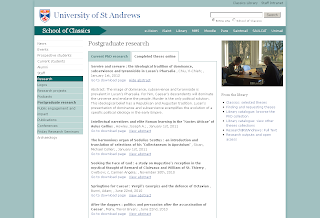
In addition there is a page that links to open access research publications by staff in Classics, all of which have full text available in Research@StAndrews:FullText
Our embedded usage stats show healthy downloads for some of these research outputs, for example 'Written Into the landscape : Latin epic and the landmarks of literary reception' (PhD thesis by James S McIntyre, 122 downloads) and 'Training athletes and explaining the past in Philostratus' Gymnasticus' (Book chapter by Dr Jason Konig, 70 downloads).
Link to School of Classics Postgraduate research and staff publications from http://www.st-andrews.ac.uk/classics/research/
Using RSS feeds and scripts to repurpose the data, the new Classics site provides a dynamic list of completed theses, with options to view abstracts and link to the full text. There are also handy links back to Library web pages with further information on finding theses and general advice on open access. (Note, not all theses are available to download immediately due to embargoes).

In addition there is a page that links to open access research publications by staff in Classics, all of which have full text available in Research@StAndrews:FullText
Our embedded usage stats show healthy downloads for some of these research outputs, for example 'Written Into the landscape : Latin epic and the landmarks of literary reception' (PhD thesis by James S McIntyre, 122 downloads) and 'Training athletes and explaining the past in Philostratus' Gymnasticus' (Book chapter by Dr Jason Konig, 70 downloads).
Link to School of Classics Postgraduate research and staff publications from http://www.st-andrews.ac.uk/classics/research/
Thursday, 2 June 2011
Discovering open access repository contents
Our Library e-resources blog recently described how you can now find full text resources from OAIster through our Discovery Service SEEKER. See the full details in this post.
OAIster harvests records from worldwide institutional repositories including Research@StAndrews:FullText and makes them easily searchable.
A similar service that allows you to search and find open access resources in repositories is BASE (Bielefeld Academic Search Engine). Outputs from a specific repository can be found by refining your search results in the Collection drop-down list.

The Directory of Open Access Repositories OpenDOAR also provides a search service for material in its directory at http://www.opendoar.org/search.php

OAIster harvests records from worldwide institutional repositories including Research@StAndrews:FullText and makes them easily searchable.
A similar service that allows you to search and find open access resources in repositories is BASE (Bielefeld Academic Search Engine). Outputs from a specific repository can be found by refining your search results in the Collection drop-down list.

The Directory of Open Access Repositories OpenDOAR also provides a search service for material in its directory at http://www.opendoar.org/search.php

Subscribe to:
Posts (Atom)